When you are stressed, you tense up. You clench your jaw, hike your shoulders, and tighten your stomach. This is a two-way street. If your body is tense, your brain thinks there is a threat. Even if you are lying in a safe, warm bed.
To convince your brain to sleep, you must physically release that tension. But often, we are so accustomed to the tension that we don't even notice it anymore. We think we are relaxed, but our shoulders are at our ears.
Enter Progressive Muscle Relaxation (PMR). Developed by Dr. Edmund Jacobson in the 1920s, it is the clinical gold standard for anxiety-induced insomnia. It works via the "Pendulum Effect": By tensing a muscle to 100%, when you release it, it swings back to 0% tension (deeper than before).
The Protocol (The Body Scan)
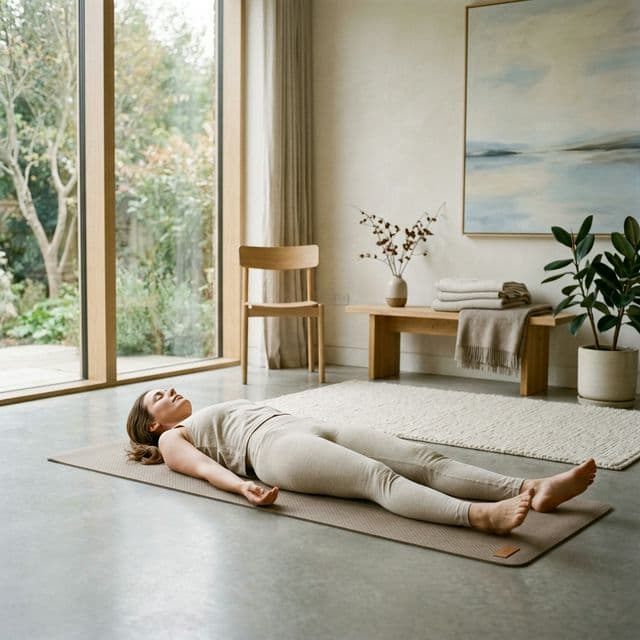
Time: 10 Minutes. Location: In bed, lights off.
For each muscle group:
- Inhale and Tense hard (squeeze) for 5 seconds.
- Exhale and Release suddenly (don't ease off; let go all at once).
- Wait for 10 seconds, noticing the wonderful difference between tension and relaxation.
1. Hands & Arms
- Make tight fists. Pull your forearms toward your shoulders (bicep curl).
- SQUEEZE. (1... 2... 3... 4... 5).
- RELEASE. Feel the blood flow back into your fingertips. Feel them get heavy.
2. The Face (The Mask)
- Wrinkle your forehead. Squeeze your eyes shut. Clench your jaw. Press your tongue to the roof of your mouth. Make a "prune face."
- SQUEEZE.
- RELEASE. Feel your forehead go smooth. Let your jaw hang open slightly.
3. The Shoulders (The Stress Carry)
- Shrug your shoulders up to your ears. Try to touch them.
- SQUEEZE.
- RELEASE. Drop them heavy. Act like gravity just doubled.
4. The Chest & Stomach (The Core)
- Take a deep breath and hold it. Tighten your abs like someone is about to punch you.
- SQUEEZE.
- RELEASE. Exhale audibly (Whoosh). Let your stomach go soft.
5. The Legs & Feet
- Curl your toes downward. Squeeze your thigh muscles and glutes. Lock your knees.
- SQUEEZE.
- RELEASE. Let your legs turn into concrete. They are too heavy to move.
6. The Final Scan
- Lie still. Imagine a wave of warm, golden oil pouring over your head, washing down your body, taking any last bit of tension out through your toes.
Why This Works
PMR does two things:
- Biological: It manually lowers cortisol and blood pressure.
- Psychological: It forces you to focus on your body sensations ("Interoception"), which pulls you out of the "Rumination Loop" (worrying about the future). You cannot worry and focus on your big toe at the same time.
FAQ: PMR
I got a cramp.
Stop tensing that area. Massage it. Next time, tense only to 70% effort. You don't need to hurt yourself.
I fell asleep halfway through.
Good. That is the point. If you fall asleep at the "Shoulders" stage, you win.
Can I do a shorter version?
Yes. If you are at a desk, just do the Shoulders and Hands. These are the two biggest tension holders.
Conclusion
Your body is the vessel for your stress. Emptying it out physically is often the only way to quiet the mind.
Try This Tonight: Do the Face Squeeze right now. Release. Notice how much tension you were holding in your jaw without knowing it.
Next Read:
Budget Wellness Editorial
Wellness Researcher
Specializing in zero-cost mental wellness strategies and breathing techniques.
Join Our Wellness Community
Get one daily, zero-cost wellness habit delivered straight to your Telegram. No noise, just peace.
Join Telegram Community