Sleep is the single most effective performance enhancer known to humans. It regulates hormones, cleans neurological toxins (via the Glymphatic system), and repairs muscle.
Yet, most of us are terrible at it. We engage in behaviors that actively fight our biology, and then try to buy sleep back with expensive mattresses and melatonin gummies.
The truth? Your body already knows how to sleep. You just need to trigger the right signals. Here are 7 zero-cost, science-backed protocols to reset your circadian rhythm.
1. Morning Sunlight (The "Anchor")
Mechanism: Cortisol Pulse.
If you want to sleep better tonight, start this morning. The Protocol: View bright light (ideally outdoors) within 60 minutes of waking up.
- Time: 10-20 minutes.
- Why: Light hitting the retina triggers a healthy spike of Cortisol early in the day. This "starts the clock" for Melatonin release ~12-14 hours later.
- Note: Doing this through a window is 50x less effective. Go outside.
2. The "Caffeine Curfew"
Mechanism: Adenosine Receptors.
Caffeine doesn't give you energy; it just blocks the "sleepiness signal" (Adenosine). It has a half-life of roughly 5-7 hours. If you drink a coffee at 4 PM, 50% of it is still in your brain at 10 PM. The Protocol: No caffeine after 2:00 PM.
- The Cost: $0.
3. Thermal Regulation (The Drop)
Mechanism: Core Body Temperature. Your core body temperature must drop by about 2-3 degrees Fahrenheit to initiate sleep. If you are too hot, you will wake up.
The Protocol:
- Ambient Temp: Keep the bedroom cool (around 65°F / 18°C).
- The Warm Bath Hack: Taking a warm bath/shower before bed actually cools you down. Why? It brings blood to the surface of the skin, which then radiates heat away from the core when you step out.
4. The 4-7-8 Breathing Hack
Mechanism: Parasympathetic Activation.
If you are lying awake with a racing heart, you need to manually slow the system down. The Protocol:
- Inhale through nose for 4 seconds.
- Hold breath for 7 seconds.
- Exhale through mouth (whoosh sound) for 8 seconds.
- Repeat 4 times.
5. Mental "Offloading" (The Worry List)
Mechanism: Reducing Rumination.
Insomnia is often just anxiety in the dark. We lay awake thinking about tomorrow's to-do list. The Protocol: 2 hours before bed, write down your "To-Do" list for tomorrow on a physical piece of paper.
- Why: This convinces your brain that the tasks are safe and accounted for, allowing it to go offline. "It's on the paper, I don't need to hold it."
6. The "No-Clock" Rule
Mechanism: Psychological Stress.
Staring at the clock and calculating ("If I fall asleep now, I'll get 5 hours...") creates a feedback loop of stress (cortisol), which keeps you awake. The Protocol: Turn your clock away. If you wake up in the night, do not look at the time. Assume you have plenty of time left. Just close your eyes and rest.
7. NSDR (Non-Sleep Deep Rest)
Mechanism: Brainwave entrainment.
If you can't sleep, don't get frustrated. Do NSDR (or Yoga Nidra). This is a guided deep relaxation that mimics the restorative effects of slow-wave sleep. Even if you don't fall asleep, 20 minutes of NSDR is biologically restorative. (Search "NSDR" on YouTube or use a Body Scan).
Conclusion
Sleep is free medicine. By respecting your biology—light, temperature, and timing—you can reclaim the rest you deserve without a prescription.
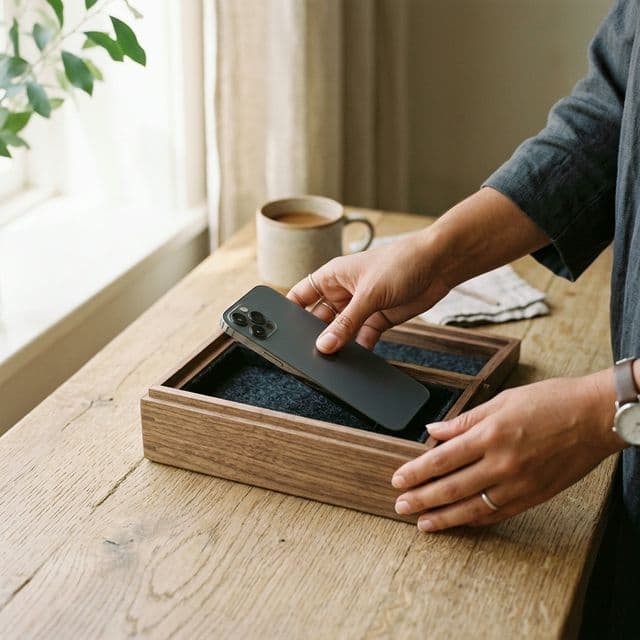
Try This Tonight: Set your "Caffeine Curfew" and put your phone away 1 hour before bed.
Next Read:
Budget Wellness Editorial
Wellness Researcher
Specializing in zero-cost mental wellness strategies and breathing techniques.
Join Our Wellness Community
Get one daily, zero-cost wellness habit delivered straight to your Telegram. No noise, just peace.
Join Telegram Community