You've probably heard the phrase "calm down." As if it were a choice. As if you could just decide to not be anxious.
Here's the truth: When your nervous system is dysregulated, willpower doesn't work.
Your sympathetic nervous system (fight or flight) is activated. Your heart is racing, your muscles are tense, your thoughts are spiraling.
You need to activate your parasympathetic nervous system (rest and digest). And there are biological hacks to force this switch.
How Your Nervous System Works
Think of your nervous system like a see-saw:
| Sympathetic (Fight/Flight) | Parasympathetic (Rest/Digest) | |---------------------------|------------------------------| | Heart rate UP | Heart rate DOWN | | Shallow breathing | Deep breathing | | Muscles tense | Muscles relaxed | | Digestion stops | Digestion active | | Cortisol flooding | Oxytocin flowing |
When you're anxious, you're stuck on the left side. The goal is to tip the see-saw to the right.
The 5 Fastest Resets
1. Cold Exposure (30 Seconds)
The Science: Cold water triggers the Mammalian Dive Reflex, which forces your heart rate to drop.
How To:
- Splash ice-cold water on your face
- Hold ice cubes to your wrists or temples
- Take a cold shower (even 30 seconds works)
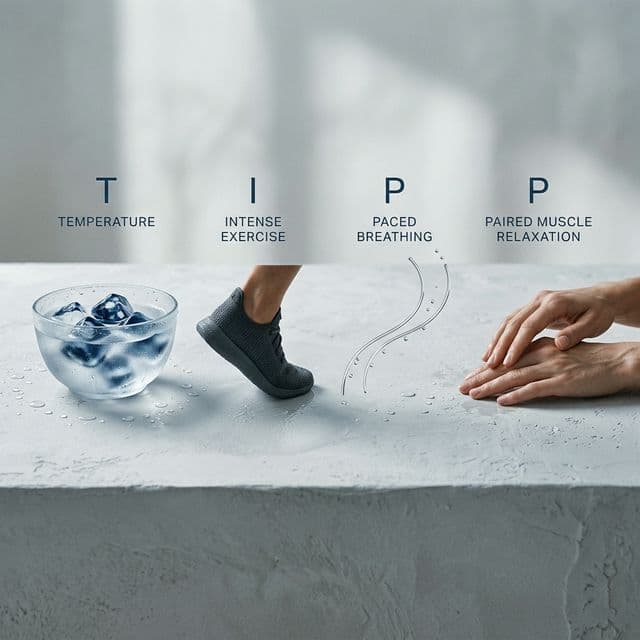
This is the "T" in the TIPP Technique.
2. Extended Exhale Breathing (2 Minutes)
The Science: Long exhales stimulate the vagus nerve, which activates parasympathetic mode.
How To:
- Inhale for 4 seconds
- Exhale for 8 seconds (the exhale must be LONGER)
- Repeat 6-8 times
The longer the exhale, the stronger the calming effect.
3. The Valsalva Maneuver (15 Seconds)
The Science: This technique directly stimulates the vagus nerve and drops heart rate immediately.
How To:
- Take a deep breath
- Close your mouth and pinch your nose
- Try to exhale against the closed airway (like you're straining)
- Hold for 10-15 seconds
- Release and breathe normally
Warning: Don't do this if you have heart conditions. Check with a doctor if unsure.
4. Humming or Chanting (1 Minute)
The Science: Humming vibrates the vagus nerve, which runs through your throat.
How To:
- Hum a single note ("Mmmmmm") for as long as your exhale
- Or chant "Om" slowly
- Feel the vibration in your chest
This is why singing in the car feels calming—it's vagal stimulation.
5. The Physiological Sigh (30 Seconds)
The Science: This is the pattern your body uses naturally when sobbing or waking from sleep. It's the fastest known way to calm down.
How To:
- Take a full inhale through your nose
- At the top, take a SECOND quick inhale (to fully expand lungs)
- Long, slow exhale through your mouth
- Repeat 2-3 times
Research shows this works faster than meditation or box breathing.
When to Use Each
| Situation | Best Reset | |-----------|-----------| | At home, full meltdown | Cold exposure | | In a meeting, can't be obvious | Extended exhale | | Need fastest possible reset | Physiological sigh | | Driving/alone | Humming | | Extreme anxiety | Valsalva + Cold |
Conclusion
You cannot "think" your way out of a dysregulated nervous system. But you CAN use your body to flip the switch.
Pick ONE technique. Practice it when you're calm. Then it will be automatic when you need it.
Try This Now: Do 3 Physiological Sighs right now. Double inhale, long exhale. Notice how your shoulders drop.
Next Read:
Budget Wellness Editorial
Wellness Researcher
Specializing in zero-cost mental wellness strategies and breathing techniques.
Join Our Wellness Community
Get one daily, zero-cost wellness habit delivered straight to your Telegram. No noise, just peace.
Join Telegram Community