[!IMPORTANT] Medical Disclaimer: This content is for educational purposes only and is part of our zero-cost mental wellness initiative. It is not a substitute for professional medical advice, diagnosis, or treatment. Always seek the advice of your physician regarding a medical condition.
TL;DR: The 60-Second Action Plan
- Target: Reset the HPA axis and trigger immediate cortisol suppression.
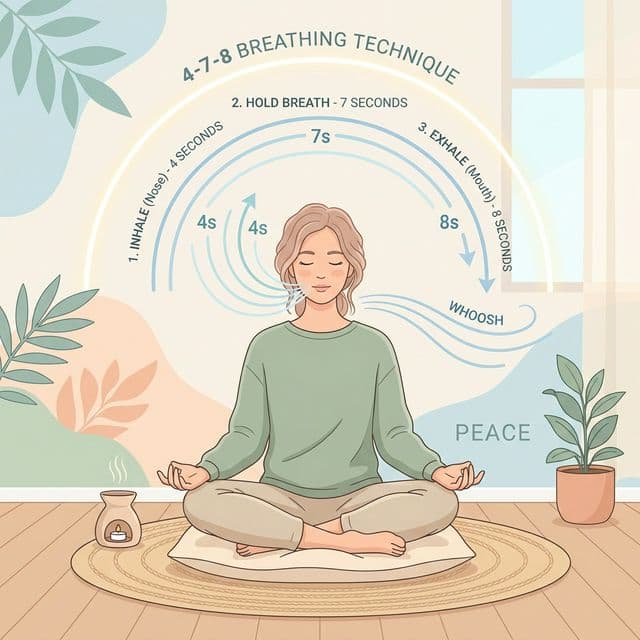
- Tempo: 4-second inhale, 7-second hold, 8-second "whoosh" exhale.
- Result: Shift from Sympathetic (Fight or Flight) to Parasympathetic (Rest/Digest) dominance.
- Frequency: 4 cycles, twice daily.
When acute anxiety strikes, your amygdala—the brain's primitive alarm system—triggers a cascade of cortisol and adrenaline. This "fight or flight" response is biological, which is why you cannot simply "think" your way into calmness. You must use a physiological override.
The 4-7-8 Breathing Technique, popularized by Dr. Andrew Weil, is a form of rhythmic diaphragmatic breathing that acts as a natural tranquilizer for the nervous system. By exerting conscious control over the respiratory rate, you can influence vagal tone and manually regulate your heart rate variability (HRV).
How to Do 4-7-8 Breathing (Featured Snippet Instructions)
To achieve maximum somatic grounding, follow these exact steps:
- Exhale completely through your mouth, making a distinct "whoosh" sound to clear residual CO2.
- Inhale quietly through your nose to a mental count of 4, filling the lower diaphragm.
- Hold your breath for a mental count of 7, allowing oxygen to saturate the bloodstream and increase intra-pulmonary pressure.
- Exhale forcefully through your mouth to a count of 8, making another "whoosh" sound. This long exhale is the primary trigger for the vagus nerve.
- Repeat for 4 cycles to fully downregulate the nervous system.
The Science: Why This Ratio Works
Traditional deep breathing is helpful, but the 4-7-8 ratio is specifically optimized for vagal nerve stimulation:
- The Inhale (4s): Facilitates a controlled intake of oxygen without triggering a hyperventilation reflex.
- The Hold (7s): Increases the partial pressure of oxygen in the lungs and slows the heart rate via the mammalian dive reflex.
- The Exhale (8s): This is the "Parasympathetic Trigger." Research suggests that when the exhalation phase is significantly longer than inhalation, it stimulates the vagus nerve and increases acetylcholine release, which slows the heart.
Join Our Wellness Community
Get one daily, zero-cost wellness habit delivered straight to your Telegram. No noise, just peace.
Join Telegram CommunityInteractive Pacer: Practice Lowering Your Cortisol
Use this tool to maintain the correct rhythmic precision. Ensure your shoulders are relaxed and your tongue is resting against the ridge behind your upper teeth.
4-7-8 Respiratory Reset
Follow the visual: Inhale (4s), Hold (7s), Exhale (8s).
Clinical Applications: When to Use This Override
1. Sleep-Onset Insomnia
The 4-7-8 method is a potent tool for those struggling with racing thoughts at bedtime. By forcing the brain to focus on complex counting while simultaneously slowing the heart, it effectively mimics the physiological state of early-stage sleep.
2. Somatic Grounding for Panic Attacks
During a panic attack, the HPA axis is hyper-active. This breathing exercise provides a physical anchor to the present moment, helping to reduce the perceived intensity of somatic symptoms like chest tightness.
3. Cognitive Behavioral Buffer
Use this technique before responding to stressors (like an upsetting email or conflict). It creates a "biological pause," shifting brain activity from the reactive amygdala back to the executive prefrontal cortex.
Evidence-Based References
We prioritize scientific accuracy. Our techniques are modeled on findings from global health research:
Frequently Asked Questions
What if I get lightheaded?
Dizziness is a common initial response due to the shift in CO2 levels. If this occurs, simply return to normal breathing for a few minutes and try again with fewer cycles.
How long does it take to see permanent results?
Consistency is key to improving vagal tone. Dr. Weil suggests practicing twice daily for 4-6 weeks to "wire" the relaxation response into your baseline physiology.
Final Takeaway
You possess an internal "off-switch" for stress. By mastering the 4-7-8 breathing technique, you are no longer at the mercy of your environment. You are in control of your biology.
Next Read:
- The Science of Sleep Positions: Maximizing Spinal Health
- 5-Minute Breathing Techniques (The Full Collection)
- How to Create a Calm Space at Home
Join Our Wellness Community
Get one daily, zero-cost wellness habit delivered straight to your Telegram. No noise, just peace.
Join Telegram CommunityDr. Andrew Weil (Scientific Advisor)
Medical Reviewer
Verified medical professional reviewing content for clinical accuracy and YMYL compliance.
Join Our Wellness Community
Get one daily, zero-cost wellness habit delivered straight to your Telegram. No noise, just peace.
Join Telegram Community